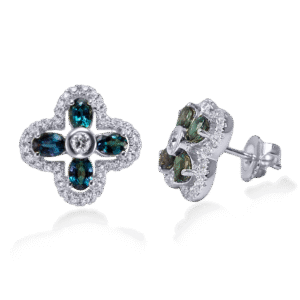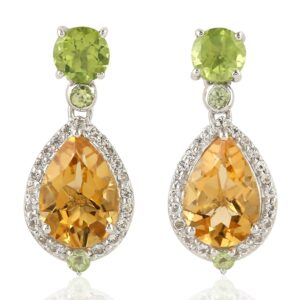


Copper-bearing gem tourmaline—recognizable by its vivid neon blue to green color—has been one of the most popular colored gemstones on the market for the nearly three decades since its debut (figures 1 and 2). It was first discovered in the state of Paraíba in northeastern Brazil in the late 1980s, and subsequently found in the neighboring state of Rio Grande do Norte (Fritsch et al., 1990; Shigley et al., 2001; Furuya, 2007). These gems became known as Paraíba tourmalines after the locality of their discovery. In the early twenty-first century, similarly colored gem-quality tourmalines were discovered in Nigeria and Mozambique (figures 3 and 4; Smith et al., 2001; Abduriyim and Kitawaki, 2005).
In the gem market, Brazilian Paraíba tourmalines are typically more highly valued than their African counterparts. While top-quality Brazilian Paraíba tourmalines tend to have more intense color, there is significant overlap in the color range for all localities. Additionally, standard gemological tests cannot definitively separate stones from these three localities. As a result, there is market demand for gemological laboratories to offer origin determination for copper-bearing tourmalines.
Most of Brazil’s Paraíba tourmaline mining sites are primary deposits in pegmatites that intruded quartzites or metaconglomerates between 530 and 480 million years ago (Ma) (Beurlen et al., 2011). Nigerian and Mozambican mines occur as secondary deposits where the tourmalines are recovered from alluvium rather than the original host rock (e.g., Laurs et al., 2008; Milisenda, 2018a). Paraíba tourmaline’s microscopic inclusions and gemological properties, however, are similar among the deposits on both continents, suggesting a very similar geological formation for copper-bearing tourmalines collected from primary and secondary deposits.